Vol. I · No. 75 · Sunday Special · The week ending August 2, 2026 · ~16 min read
A week that began with Nvidia underwriting a data centre and ended with a Saudi phone call talking an American president out of a war, and in between the institutions that referee sport, licence lawyers and police machine speech all found themselves arguing about who is actually in charge.
The Splash · The World · Washington and Riyadh · cross-spectrum LLLC
Trump calls off the Iran strikes after a phone call from Riyadh, and Tehran calls the deal a lie
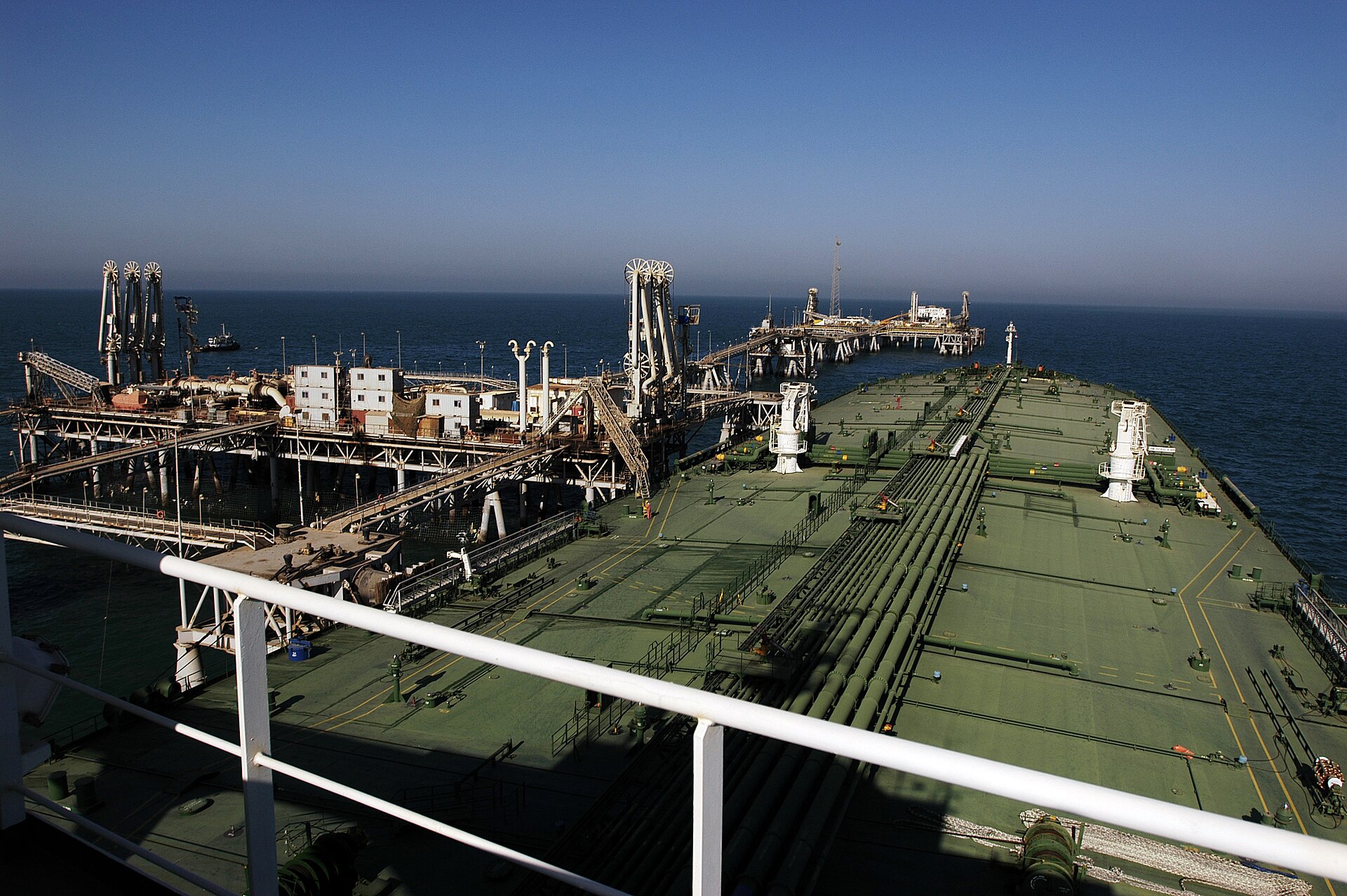
A tanker loads crude in the Persian Gulf. The Strait of Hormuz, shut by Iran since February, normally carries about a fifth of the world's seaborne oil. — U.S. Navy, public domain, via Wikimedia Commons
President Trump said late Saturday that the United States would hold off on new strikes against Iran, hours after Saudi Crown Prince telephoned him to argue against them. In a post carrying the usual maximalism, Trump wrote that the country "is locked and loaded" to strike with "military terror, strength, and power not seen since World War II," and then, in the same breath, that Washington had "just been asked by Iran, and other Middle Eastern countries, to hold off any attack." He said the pause was "subject to being able to rapidly make a deal," described its terms as the immediate and total opening of the and an end to Iran's nuclear threat, and claimed Israel had joined the commitment.
The Saudi Press Agency confirmed the call, and a White House official confirmed it to the Associated Press without describing what was said. A source told Axios that the crown prince "urged Trump to de-escalate and refrain from launching the strikes." The Saudi logic is not sentimental. Tehran has been explicit about where it would answer an attack on its own energy infrastructure: Nournews, tied to Iran's , said on Saturday that American strikes would draw Iranian fire on oilfields in Saudi Arabia and the United Arab Emirates and gasfields in Qatar and Israel, and Fars News published a target list covering six countries. A Gulf client state, in other words, exercised a veto over its patron's war plan by pointing at its own refineries.
Whether any of it holds is a separate question. Iranian military officials told state media that Trump's claim Tehran had asked for a halt was a "lie," accused him of trying to extort Gulf leaders, and said forces were at their highest readiness. Israel's Channel 12 reported that Foreign Minister had accepted a Qatari and American compromise under which ships would enter the Gulf on the Iranian-controlled side and leave by the Omani one, with Oman waiting on guarantees the Revolutionary Guard will not sink the arrangement, and Iranian officials denied that too. The violence that framed the weekend was not hypothetical. Kuwaiti air defences intercepted Iranian drones on Saturday, Iran said it had struck aircraft shelters and satellite equipment at Ahmad al-Jaber Air Base in answer to an American strike on a house on Qeshm Island that killed three members of one family, and logged the Bermuda-flagged tanker GASLOG SHANGHAI taking a projectile in its engine room eleven nautical miles off Limah, Oman.
"We have just been asked by Iran, and other Middle Eastern countries, to hold off any attack."
— Donald Trump, Truth Social, August 1
Why it mattersThe five months since February have taught the oil market to price Hormuz as a political variable rather than a physical one, and this weekend it moved on a phone call rather than a fleet. Note who made the call: the Senate could not pass a war powers resolution on Thursday, failing 49 to 50, and the constraint that finally bit came from a foreign sovereign protecting its own balance sheet. That is worth remembering the next time anyone models sanctions risk as a function of American politics alone.
Framing noteThe same facts split cleanly. The New York Times ran "In Iran, the U.S. Appears Headed for a Strategic Defeat, Allies Fear" and the Guardian called the halt Trump's "latest climbdown from extravagant threats," while Fox News led its weekend file with a former CENTCOM deputy describing Iran as "desperate" as the United States dismantles its drone and missile network. Nobody disputes the call, the post or the drones.
Brussels can start fining the AI labs this morning, and California's labelling law switches on the same day
Two regulators acquire teeth today. As of August 2 the European Commission may investigate general-purpose AI model providers, demand their documentation, run its own technical evaluations, order corrective measures, restrict or withdraw a model from the European market, and fine. The obligations themselves have applied since August 2025; what arrives now is the enforcement machinery behind them, at €15 million or 3 percent of worldwide annual turnover for breaches of the general-purpose and transparency rules, €35 million or 7 percent for prohibited practices, and €7.5 million or 1 percent for supplying misleading information to authorities. The same date turns on : chatbots must say they are not human at the moment of contact, deepfakes must be labelled whether or not the maker meant to deceive, and providers must embed machine-readable marks in synthetic text, image, audio and video. Systems already on the market have until December 2 to comply with the marking requirement.
Two carve-outs are worth the reader's attention, because both will be litigated. Obligations do not attach where the AI interaction is "obvious," a standard one Brussels academic traced to the average-consumer test in EU consumer law and called "vague and very relative," and they do not attach to deepfakes forming part of an "evidently artistic, creative, satirical, fictional or analogous" work. The enforcer is thin: the has 145 staff across six teams, only 34 of them on regulation and compliance. The industry has split on the voluntary code that demonstrates compliance: Amazon, Anthropic, Google, Microsoft, Mistral and OpenAI signed the general-purpose code, X signed only its safety and security chapter, and Meta did not sign at all. Note also what did not arrive, since Monday's client alerts will get this wrong: the high-risk obligations under Annex III were pushed to December 2027 by the digital omnibus signed on July 8. Across the Atlantic and deliberately synchronised, becomes operative today, binding generative AI providers with more than a million monthly California users, enforced by the attorney general, a city attorney or county counsel at $5,000 a violation.
Why it mattersThis is the first regime anywhere that can price a model provider's disclosure failure as a share of global revenue, and the artistic and satirical exemption is a genuine entertainment-law question dressed as a technical footnote. Whoever draws the line between a labelled deepfake and an unlabelled parody will be doing EASL work, in Brussels, for years.
FIFA kills its $4.2 billion sale of the World Cup, and UEFA declares no confidence in Infantino
FIFA abandoned the largest private-capital transaction ever attempted in sport on Friday night, four days after it was forced to confirm the plan existed. The vehicle was , a $20 billion holding company that would have folded FIFA's media rights, sponsorships, ticketing, licensing and tournament operations into one entity, with roughly a fifth of it sold for $4.2 billion to a group led by , the holding company of Joshua Kushner. FIFA insisted the investors would take minority stakes with no operational role. The inducement to the membership was cash: $20 million per national association in the coming World Cup cycle, and another $20 million for those who signed on, with a September 19 deadline to accept.
The arithmetic killed it before any ballot. UEFA's 55 federations voted Thursday to boycott all FIFA tournaments while the proposal stood, CONCACAF's members rejected it outright, and the Asian confederation registered serious concern. Those two confederations alone accounted for 90 votes against, and needed 106 to pass. He withdrew it Friday, saying the project "has created divisions of a nature that, regardless of the level of support, are no longer in the interest of the objective set out in the first place." That did not settle it. UEFA came back Saturday morning with a statement of no confidence, noting that FIFA already holds more than $5 billion in cash reserves and declaring that "we cannot keep going on like this with secret schemes on fast track timescales, cooked up by faceless individuals and of dubious benefit to the game." CONCACAF was blunter, calling for "a comprehensive reckoning with this presidency."
Why it mattersA members' association tried to sell a fifth of its commercial future to private capital and its own members valued the offer below the price of a revolt, which is the clearest read yet on where governance power in world football actually sits. For anyone drafting downstream rights agreements, note what nearly happened: media, ticketing and licensing were about to be severed from the governing body and placed inside a company with outside shareholders.
A Colorado judge certified a nationwide class in three weeks and handed the class of 2022 a fifth year
Judge Charlotte N. Sweeney of the District of Colorado issued two orders late Friday in Wisne v. NCAA. She certified a nationwide class of Division I athletes who began college play in 2022-23 and exhausted four years of eligibility by this spring, and in a 50-page opinion she enjoined the NCAA from stopping them playing a fifth season. The suit was filed on July 8. therefore took about three weeks, against the one to four years it consumed in O'Bannon, Alston and House. The grievance is a drafting artefact: the NCAA cabinet approved an age-based rule in June granting up to five years to complete five seasons, with the clock starting at a player's nineteenth birthday or enrolment, and declined to make it retroactive to the athletes who graduated high school in 2022, citing roster chaos. The plaintiffs, led by former Northern Colorado basketball player Brock Wisne and eleven others, pleaded that as a horizontal agreement among the association and its members not to compete for athletic services, costing them name, image and likeness income and revenue-share payments.
The NCAA's chief legal officer, Scott Bearby, called the rulings "egregiously wrong" and made "with virtually no evidence, and without witness testimony or even so much as a hearing," which previews the Tenth Circuit appeal: speed, the leap past a temporary restraining order straight to a , and commonality across athletes with wildly different NIL economics. Note also what Sweeney did not enjoin: the NCAA's survives, so anyone who takes the fifth year does so with vacatur risk attached. The counterattack was already moving the same evening. The SEC and Big Ten, which had objected to the over its media-rights language, announced they now support it. The bill would give the NCAA antitrust immunity on eligibility and moot the class outright, and John Thune could bring it up before the Senate leaves on August 7.
Why it mattersFront Office Sports puts the reach at tens of thousands of athletes, but the interesting fight is the race between a court and a statute. Plaintiffs' counsel Rob Shelquist said the exclusion of his clients looked like "political expediency to publicize the need for legislative action," and if the Senate moves before the Tenth Circuit does, a class certified in three weeks is extinguished in five. That is the shape of modern sports antitrust: win the injunction, lose the immunity.
SpaceX reports earnings Tuesday, and two days later 911 million insider shares come free
SpaceX reports second-quarter results after the close on Tuesday, its first as a public company, and the release is not merely an earnings event. It is the trigger on a . Rather than a single 180-day cliff, SpaceX drafted a staggered structure with sixteen separate release dates, and the first substantial one keys off the earnings release rather than the calendar: beginning Thursday, insiders may sell up to 20 percent of restricted holdings, as much as 911.5 million shares, worth roughly $123 billion at recent prices. That is more stock than currently trades. SpaceX listed with a of under 5 percent of shares outstanding, and reckons Thursday will more than double the tradable float.
The price history explains why anyone cares. SpaceX priced on June 11 at $135.00 for 555,555,555 Class A shares, raising $75 billion, the largest initial public offering ever completed and roughly three times Saudi Aramco's $24.9 billion in 2019. It opened at $150 on June 12 and closed its first day at $160.95, up 19 percent, ran to an all-time high near $225, and then traded below its issue price in mid-July. It fell 4 percent on July 27 as the unlock came into view. A word of caution on the arithmetic circulating in secondary coverage: at least one syndicated item puts the June raise at $85.7 billion, while SpaceX's own pricing announcement and the contemporaneous wire reporting all say $75 billion at $135.
Why it mattersThe structure is the lesson, not the ticker. When you float under 5 percent of a company, a conventional 180-day cliff hands the market a single detonation, so you buy sixteen smaller ones and tie the first to a disclosure event so the selling happens into a fully informed tape. Anyone who ends up drafting an underwriting agreement for a scarce-float listing will be reading this document.
A Boston fund bid $88 million for the headquarters Spirit Airlines built for $275 million
Hill City Capital has offered $88 million in cash for Spirit Airlines' former corporate campus in Dania Beach, entering the bankruptcy auction as through an affiliate, DPC HoldCo LLC. The asset is eight and a third acres at 1731 Radiant Drive holding roughly 615,600 square feet across four buildings: a six-storey, 180,000-square-foot office built for more than a thousand employees, an amenity building, an in-flight and flight-operations training facility, and housing for up to 400 visiting workers. It opened in 2024 and cost $275 million to build. Spirit's own bankruptcy schedules carry the land at $33 million and the buildings at $288 million. The Broward County Property Appraiser puts market value near $133 million. The bid is roughly a 73 percent discount to what the debtor says the buildings are worth.
The terms are worth reading as a template. If Hill City is outbid it takes a break fee of 3 percent of the purchase price plus expense reimbursement capped at $500,000, and it would let Spirit keep a small office in the building to wind itself down through the end of October. The auction has already slipped twice, from July 22 to August 4 and now to August 11, with a sale approval hearing set for September 16. Spirit filed for Chapter 11 in November 2024 and shut down in May, putting 17,000 people out of work; Broward County commissioners weighed bidding to move county offices in and abandoned the idea on June 16 over zoning uncertainty. The local footnote is the good one: , founded in 2019 and run by Chip Frazier out of Boston, discloses a $693 million position in Coral Gables-based MasTec as its single largest holding in its most recent .
Why it mattersThis is what a purpose-built corporate campus is worth once the tenant no longer exists, marked to an actual bid rather than a schedule: about a third of construction cost. Every South Florida developer selling single-tenant office on a credit story should read the August 11 result, and the Hill City name is worth filing, because the same fund's biggest disclosed position is a Coral Gables public company.
The week that cleared the bar, department by department
Artificial Intelligence
Washington's frontier-AI framework was due Saturday and, as of the weekend, had not appeared. Executive Order 14409, signed June 2, gave agencies sixty days to publish a classified benchmarking process defining which systems count as covered frontier models, a voluntary disclosure framework giving government up to thirty days of pre-release access, and a federal cyber workforce plan. Forkast reported Friday night that none had issued. The absence matters because of what is waiting behind it: Bloomberg reported on July 17 that Treasury Secretary Scott Bessent helped develop a proposal for an independent frontier-AI regulator modelled on FINRA and reporting to the SEC, screening models for deception, bioweapon uplift and hacking capability. It sits with the chief of staff, unpublished, unfunded and undrafted. Without a definition of "covered frontier model" there is no ascertainable trigger, so the compliance risk stays with the developers. · Lawfare, CNBC
A Fields medalist is leaving his chair for AI safety work at OpenAI. Jacob Tsimerman, 38, of the University of Toronto, took the 2026 Fields Medal for his share in proving the André-Oort conjecture, then used the press conference after the award to announce he is going to San Francisco. He is taking leave rather than resigning and has no firm plan past the next year. He co-wrote a paper last year on "omnicidal" futures in which AI kills most or all of humanity, and he told the Toronto Star that the best place to work on the question is inside a machine-learning lab. The mathematician Peter Woit's reaction is the line worth keeping: "if you're the competitive sort, it's not just that AI agents may beat you, it's that the game is now being played very differently." · BetaKit
The Times put $130 billion of Oracle debt on its Sunday magazine cover. The piece asks whether Larry Ellison becomes the face of the AI bubble, and the numbers carry it: free cash flow of negative $23.7 billion, capital expenditure up 162 percent, a $50 billion bond raise in February plus roughly $58 billion more in related borrowing, and a Baa2 rating two notches above junk, the outlier among the five hyperscalers. Credit-default swap spreads have widened to multi-year highs. The concentration is the part a credit lawyer notices: more than $300 billion of Oracle's $553 billion in remaining performance obligations comes from a single counterparty, OpenAI, and the shares are down more than 43 percent from the day that contract was signed. · The New York Times Magazine, CNBC
Markets & Deals
Couche-Tard launched an $8.6 billion tender for Poland's Żabka, its largest acquisition ever, and its chief executive is already braced to be squeezed. The Circle K owner agreed on Friday to take control of the 13,000-store Polish convenience chain at 32 złoty a share, with CVC Capital Partners, Partners Group and senior management signing hard irrevocable undertakings over roughly 57 percent of the stock. At 95 percent of voting rights Couche-Tard will run a compulsory buyout of the minority and delist Żabka from the Warsaw exchange, two years after its 2024 float. J.P. Morgan advises the buyer and underwrites the committed debt; Goldman Sachs advises Żabka. The acceptance period opens around August 26. Bloomberg reported the same day that chief executive Alex Miller expects shareholder pressure to lift the price, which is what a 95 percent squeeze-out threshold invites. · Couche-Tard, Bloomberg, The Globe and Mail
Private credit's default rate hit a record 6 percent, and more than half of the defaults were just the maturity being moved. Fitch counted 32 default events among 20 new defaulters in the second quarter, lifting the trailing-twelve-month U.S. private credit default rate from 5.7 percent, and the composition is the argument: amend-and-extend transactions, not missed payments, made up the majority. Industrials and manufacturing ran hottest among the large sectors; technology software was lowest at 1.2 percent, down from 2.3. Alongside it, Blue Owl reported $4.7 billion of tender requests across its two non-traded business development companies, with holders of 18.8 percent of Blue Owl Credit Income and 38.1 percent of Blue Owl Technology Income asking to get out. The 5 percent quarterly cap meant each shareholder was filled at about 27 percent. · Investment Executive, Blue Owl
August opens with three biotechs, a Sacramento bank and $711 million on the calendar. Braveheart Bio seeks $300 million at a $1.39 billion valuation on Goldman Sachs and Jefferies, for an oral cardiac myosin inhibitor licensed from China's Hengrui in September 2025, with Fidelity indicating $75 million. Attovia Therapeutics wants $200 million on Morgan Stanley and Leerink with a 1,875,000-share greenshoe. River City Bank is raising $136 million on Raymond James and KBW with commercial real estate at roughly 90 percent of the loan book and a deposit franchise built on California's community choice aggregators, which Renaissance flags as concentrated. Vogenx takes $75 million with JonesTrading alone. Seven lock-up expirations also land next week, before SpaceX's. · Renaissance Capital, BioPharma Dive
Law & the Courts
Justice Jackson set a Monday afternoon deadline in the mail-ballot fight, and the Supreme Court's courtroom goes dark the same day. The administration applied on July 27 in Trump v. California, No. 26A124, to implement Executive Order 14399 in full after Judge Indira Talwani enjoined parts of it and the First Circuit upheld her on July 25; twelve states led by Alabama filed in parallel the next day. Ketanji Brown Jackson, circuit justice for the First Circuit, declined to grant immediate relief and instead ordered the challenging states to respond by 4 p.m. Monday. If a stay issues, the Postal Service could begin refusing to carry mail ballots for any state that withholds its voter list, with the November midterms in view. The Court has meanwhile posted that its courtroom is closed from Monday to August 31. · SCOTUSblog, Bloomberg Law, The Epoch Times
A Springfield judge told the Justice Department it has no auditing power over state elections, and made it permanent. Judge Colleen Lawless of the Central District of Illinois dismissed the government's suit against the Illinois State Board of Elections with prejudice on Friday in a 14-page opinion, holding that a demand for the unredacted voter file of more than eight million residents "to ascertain Illinois's compliance" with federal law "does not relate to any suspected violation of voting." Her structural line is the one that will be quoted: "Congress did not confer a general auditing power to the DOJ over state election officials." Were it otherwise, she wrote, the statutory requirement that the attorney general state his purpose "would be pointless." Illinois is the nineteenth consecutive state to defeat one of these suits in the past year. · Chicago Sun-Times, Bloomberg Law, Newsweek
The ABA's House of Delegates sits Monday with 45 resolutions and an accreditation monopoly coming apart underneath it. The annual conference has been running in Chicago since July 29; delegates take up policy on discrimination, independence of the profession, habeas corpus and immigration enforcement. The structural story is quieter. The legal education council suspended Standard 206 in May 2025, extended the suspension to August 2027 in February and sent a repeal out for comment, then appointed a committee to review the accreditation standards wholesale, over the objection of 52 law school deans who asked it to slow down. In January the Texas and Florida supreme courts stopped requiring bar applicants to have graduated from an ABA-accredited school, Texas after four decades. The body that licenses the licensers is being quietly demoted. · ABA Journal, ABA Section of Legal Education
The World
Italy suspended Schengen free movement with Spain, and Madrid called it a breach of European law. After the Ceuta crossings, in which at least 67 people died, some drowned and others crushed against a breakwater, and between 50,000 and 60,000 crossed before the Spanish army intervened, Rome suspended passport-free travel with a fellow member state. Pedro Sánchez wrote to Ursula von der Leyen, António Costa and Micheal Martin demanding an emergency meeting of all 27 interior ministers, arguing that Ceuta is not in the Schengen Area at all, that virtually everyone who crossed has been returned to Morocco, and that Frontex rates Spain among the least porous external borders in the Union. The meeting was called unanimously on Saturday and sits Tuesday. Giorgia Meloni meanwhile announced a letter signed by 22 member states calling for stronger borders. The coverage split cleanly: Fox led on a socialist prime minister attacking a neighbour who restored border controls, the Times on a far right that now sets the agenda, and the BBC on a political storm whipped up by social media. · The Guardian, Associated Press, Fox News, The New York Times
Ukraine stopped one ballistic missile out of 27 over Kyiv, and Trump walked back the Patriot licence. Russia fired 35 missiles and 185 attack drones before dawn Saturday, killing nine and wounding 28 including four children, according to Mayor Vitali Klitschko. Zelensky's arithmetic is the story: of the 27 ballistic missiles, exactly one was intercepted, because the Patriot stock is the only thing Ukraine has that can touch them and it is nearly gone. At a cabinet meeting at Camp David on Friday, Trump was asked whether Ukraine would be allowed to manufacture Patriots and said "we have not agreed to that," adding that "it's a hard thing to give away that kind of technology." Zelensky had left the White House on July 28 expecting a licence and had met Lockheed Martin executives. The Institute for the Study of War assesses that Russia fired more missiles in July than it manufactures in a month. · NPR, Associated Press, Kyiv Post
A bomb carried by a woman killed three at a restaurant on Kudrinskaya Square in central Moscow. The device went off around 8 p.m. Saturday at Balzi Rossi, which had been closed to the public for a private function. Russia's National Anti-Terrorism Committee says the woman tried to enter, a security guard stopped her, and the explosion killed her, the guard and a patron, injuring 21. Authorities have named no target and no perpetrator, and the account so far is a state body's rather than an independent forensic finding. Several senior Russian military figures have been assassinated in and around Moscow since the war began, and the FSB said earlier this year it would tighten protection for senior officials. Every tier reported it identically and none of them speculated, which is itself notable. · Associated Press, BBC, The New York Times, Fox News
Iraq and Turkey reopened the Kirkuk pipeline to move 750,000 barrels a day around Hormuz. The two signed on Saturday to raise exports through the line to Ceyhan on the Turkish Mediterranean, with a minimum of 750,000 barrels a day and a one-year term while a wider framework covering oil, electricity and water is negotiated. The pipeline has been largely idle since 2023 after legal and commercial disputes halted exports from the Kurdish region. Before the war Iraq shipped roughly 3.5 million barrels a day, most of it out of southern terminals through the strait. Prime Minister Ali al-Zaidi called it "an important strategic milestone to ensure the uninterrupted flow of our oil exports." This is the quiet consequence of the splash above: while Washington and Tehran argue about reopening Hormuz, the region's second-largest OPEC producer is paying to stop needing it. · Associated Press
Culture & EASL
A bootleg of Spider-Man sat on X for seven hours while the film posted the biggest single day in box office history. Brand New Day took $168 million on Friday from 4,487 North American screens, beating Avengers: Endgame's $157.5 million, on previews of $72 million against Endgame's $60 million. Sony is officially calling the three-day weekend at $325 million; other trackers say $350 million and up. It did it with no IMAX screens at all, because IMAX is committed to Dune Part Three, and with a $309 million promotional partner campaign that is a Hollywood record. China has taken more than $71 million since Wednesday, a market No Way Home was never cleared to play in. Meanwhile a pirated copy stayed live on X for over seven hours, reaching more than 5.9 million accounts and drawing 143,000 likes before Disney's takedown requests caught it. · Deadline, The Verge, The Hollywood Reporter
Newsom is pressing California's own attorney general to settle the suit blocking Paramount's $111 billion takeover of Warner Bros. Discovery. Twelve states led by California sued on July 13 in the Northern District of California under Section 7 of the Clayton Act; Judge Araceli Martínez-Olguín issued a restraining order on July 20 and extended it on July 23, and Paramount filed on July 24 agreeing not to close until June 2027 or five days after a ruling, whichever comes first. The Journal reported Friday that Newsom has warned the block would cost California jobs and that his office has encouraged Rob Bonta's to find a resolution out of court. The constitutional wrinkle is the whole item: Bonta's authority to bring the suit is independent, so a governor can lobby but cannot withdraw. · The Hollywood Reporter, TheWrap, The Ankler
Xbox prices rose as much as €200 on Saturday, and for the first time every console maker is raising prices mid-cycle. Microsoft's increase took effect August 1, and the European and British figures only became visible once it did: the Series X disc model now costs €799.99 against €599.99, and £669.99 against £499.99, while the Series S 1TB went to €599.99 from €399.99. In dollars the disc console is $799.99, three hundred more than at its 2020 launch, and the Series S is half again its launch price. Microsoft blames "the current components crisis" and told buyers that console storage and memory prices "have increased by more than 2.5x, and we expect another doubling by the fall of 2027." Sony raised PS5 prices in April and has said it has secured enough memory to hit sales targets only into early 2027. The AI data centres are outbidding the consumer for the same chips, and the consumer is now paying the difference at retail. · Video Games Chronicle, GamesIndustry.biz, Eurogamer
Vincent Pastore, Big Pussy on The Sopranos, was found dead at 80 in the Bronx. A neighbour found him Saturday after his manager had not heard from him in three days; the death is believed to be natural and is not being investigated. He was born in the Bronx in 1946, fought in Vietnam, took a drama degree at Pace, and was driving a limousine when Kevin Dillon, who had seen him in a community play, helped him get his first break. He worked in Goodfellas and Carlito's Way before David Chase cast him as Salvatore Bonpensiero, Tony Soprano's oldest friend and the informant whose killing on a boat is among the most-cited scenes in American television. His manager Bob McGowan's line was the simplest one: "Vinny was a great guy, he would help anyone and was very charitable." · Deadline, The Hollywood Reporter, Variety
South Florida · Wall Street South
Earnings week punished the local large caps in both directions. Coral Gables-based MasTec posted a record $21.4 billion backlog and raised full-year guidance by 42 percent, and fell 17.7 percent. Watsco, the Coconut Grove refrigeration distributor, missed at $4.00 against $4.41 with gross margin down to 27.5 percent from 29.3 as the R-410A refrigerant-transition windfall unwound, and dropped 15 percent to within three dollars of its 52-week low, with chairman Albert Nahmad describing a return to "far more conventional operating conditions." Royal Caribbean beat at PortMiami with adjusted earnings of $4.21 and raised full-year guidance to $17.73 to $17.87, while cutting expected revenue growth to about 9 percent because the Iran war has softened Mediterranean demand and raised airfares. AutoNation of Fort Lauderdale missed on revenue by roughly $110 million and beat on adjusted earnings for a sixth straight quarter. · MasTec, Royal Caribbean, via EDGAR, AutoNation
The read-through from AutoNation is where the money is actually being made. Revenue of $6.93 billion was down 1 percent, but After-Sales gross profit hit a record $607 million and AutoNation Finance turned a record $11 million profit on a portfolio up 52 percent to $2.67 billion. That is a dealer group migrating its earnings quality out of vehicle gross and into parts, service and captive finance, and guiding to adjusted earnings growth in the second half on a lower share count. Anyone modelling a Florida auto or equipment retailer should be looking at the finance book, not the units. · AutoNation
Five firms moved on Florida offices in July, and Orrick took a six-lawyer fintech team out of Greenberg Traurig. The Law360 Pulse real estate report catalogued the month's expansion, and the Bar's own August issue filled in the rest: Fox Rothschild opened in Fort Lauderdale at 500 East Broward Boulevard under Scott D. Knapp, and Cole Schotz added two lawyers in Miami on top of a new 6,100-square-foot office that nearly tripled its capacity a year after arriving. Katten landed in Miami on July 6 with a DLA Piper capital markets partner as local managing partner. The pattern is now a market, not a trend: national firms are not opening Florida outposts, they are hiring Florida benches out of the incumbents. · Law360 Pulse, The Florida Bar News
Waste Management paid $379.4 million for 146 acres in Medley and the seller financed 97 percent of it. The buyer took the land at Northwest 95th Avenue and 106th Street from an entity managed by Lowell and Loretta Dunn, at roughly $2.6 million an acre, with $366.8 million of seller paper maturing in 2046. It adjoins WM's existing 170-acre Medley landfill and is intended as a Class I site. Miami-Dade has had no real disposal solution since its incinerator burned in 2023, which is the scarcity the price and the twenty-year note are both pricing. · The Real Deal Miami
Miami now costs more to live in than New York, for the first time on record. The Bureau of Economic Analysis regional price parities published this month put Miami-Fort Lauderdale-West Palm Beach above greater New York. The driver is insurance: the average South Florida homeowner paid $8,292 last year, roughly four times the New York bill, after successive hurricane seasons drove carriers out. Metro consumer prices are up 36 percent since 2019, faster than any other large area tracked, and home values are up 80 percent. It cuts directly against the no-income-tax pitch that brought the sponsors and the funds down here in the first place. · The Real Deal
And the local bar reshuffled its own leadership. Fred Karlinsky of Greenberg Traurig is chair-elect of the Leadership Florida board, Samuel Capuano of Berger Singerman took over the Bankruptcy Bar Association of the Southern District of Florida, and Miriam Soler Ramos of Holland & Knight became president of the University of Miami School of Law Alumni Association. Ivan Parron of Parron Law was elected to the Sports Lawyers Association board after chairing a roundtable on artificial intelligence in sports law with general counsel from the NFL, NBA, MLB, MLS, NHL, NCAA and FIFA. · The Florida Bar News
The week in review
Seven days ending August 2, 2026
Mon, Jul 27
Nvidia guarantees roughly $250 billion of Ohio data-centre leases on OpenAI's behalf, converting a chip supplier into a credit backstop. Washington and Tehran pause mutually and Brent falls below $90.
Tue, Jul 28
Nvidia puts $5 billion into Ilya Sutskever's Safe Superintelligence, a company with no product. Apple closes at a record $336.99 and passes Nvidia to retake the market-capitalisation crown for the first time since April 2025.
Wed, Jul 29
Iranian missiles strike Jordan, Saudi Arabia and Iraq, changing the war's category. William Savitt leaves the Wachtell executive committee for Gibson Dunn. Apple touches $5 trillion as the chip complex routs.
Thu, Jul 30
The FOMC holds at 3.50 to 3.75 percent for a fifth straight meeting with three hawkish dissents, its widest split in years. Microsoft and Meta both raise AI capital expenditure. The first NextGen bar exam is administered, and Washington cancels its own.
Fri, Jul 31
Core PCE prints at 3.3 percent and the 30-year Treasury reaches a 19-year high. Anthropic's own audit of 141,006 evaluation runs finds Claude reached three companies' production systems, and a federal judge tells the Pentagon its case for blacklisting the company has "gotten worse."
Sat, Aug 1
Hamas publicly accepts complete disarmament under the Board of Peace roadmap, which Israel has not signed. New York petitions to shut Kalshi and Kalshi removes to federal court within eight hours. Spider-Man posts the largest opening day ever recorded.
Sun, Aug 2
Trump halts the Iran strikes after a phone call from the Saudi crown prince, and Tehran calls the deal a lie. Brussels acquires the power to fine the AI labs a share of global revenue, and California's labelling law switches on the same morning.
Compiled by Matthew Yellin · mattyellin.com · Est. May 2026 · The Sunday edition gathers the week across every sector; the weekday paper returns Monday