How do you find out whether a medicine works? In 1747 a navy surgeon split twelve sick sailors into pairs, gave each pair a different cure and waited to see who got up. Every pill you take was tested the same basic way.
George Anson
1,854
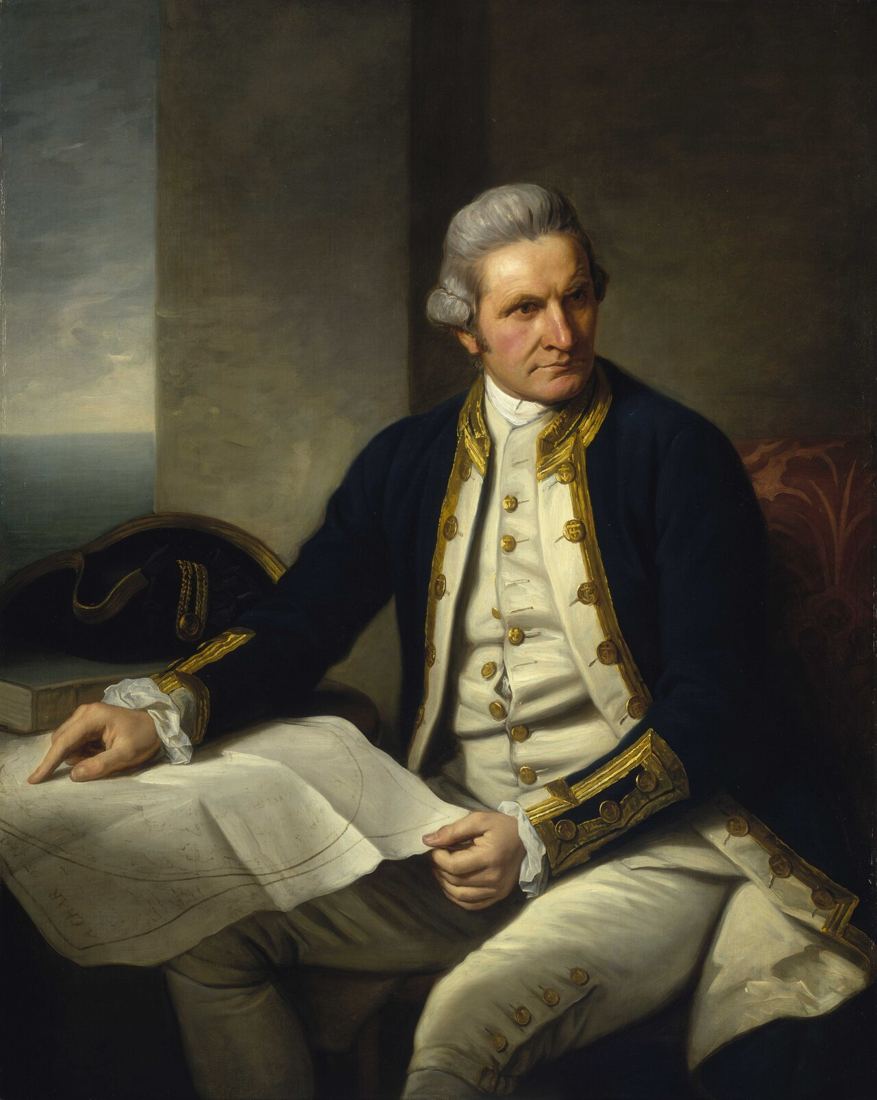
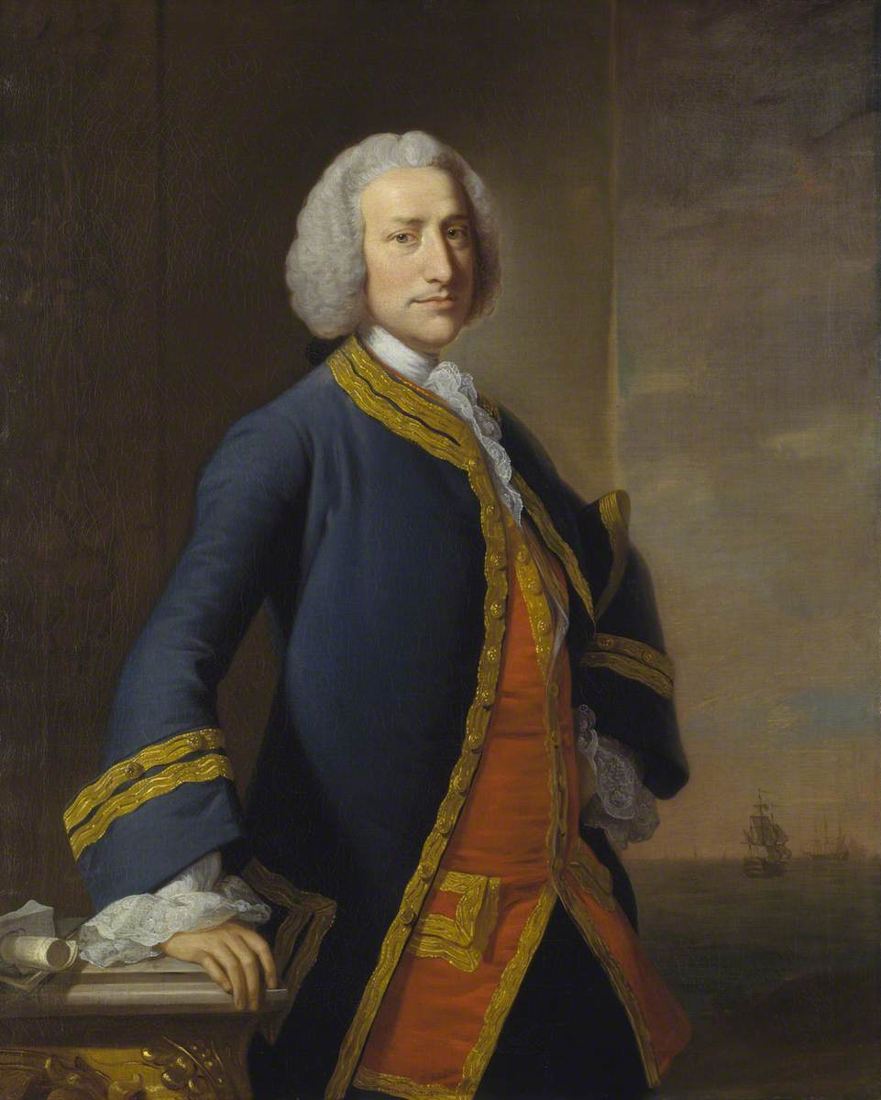
1740. Commodore George Anson sails from England with eight ships, ordered round the world.
He takes 1,854 men. Each dot is ten of them.
He comes home with 188.
On one ship alone, at least 380 of 510 men died of the same disease.
It was scurvy. Gums rotted, old wounds reopened, and bones that had healed years before broke again.
Nobody knew what caused it. Cures were everywhere, from lemons to cider to sea water, and nobody could say which of them worked. In May 1747, on a warship called the Salisbury, a surgeon of thirty named James Lind decided to stop guessing.
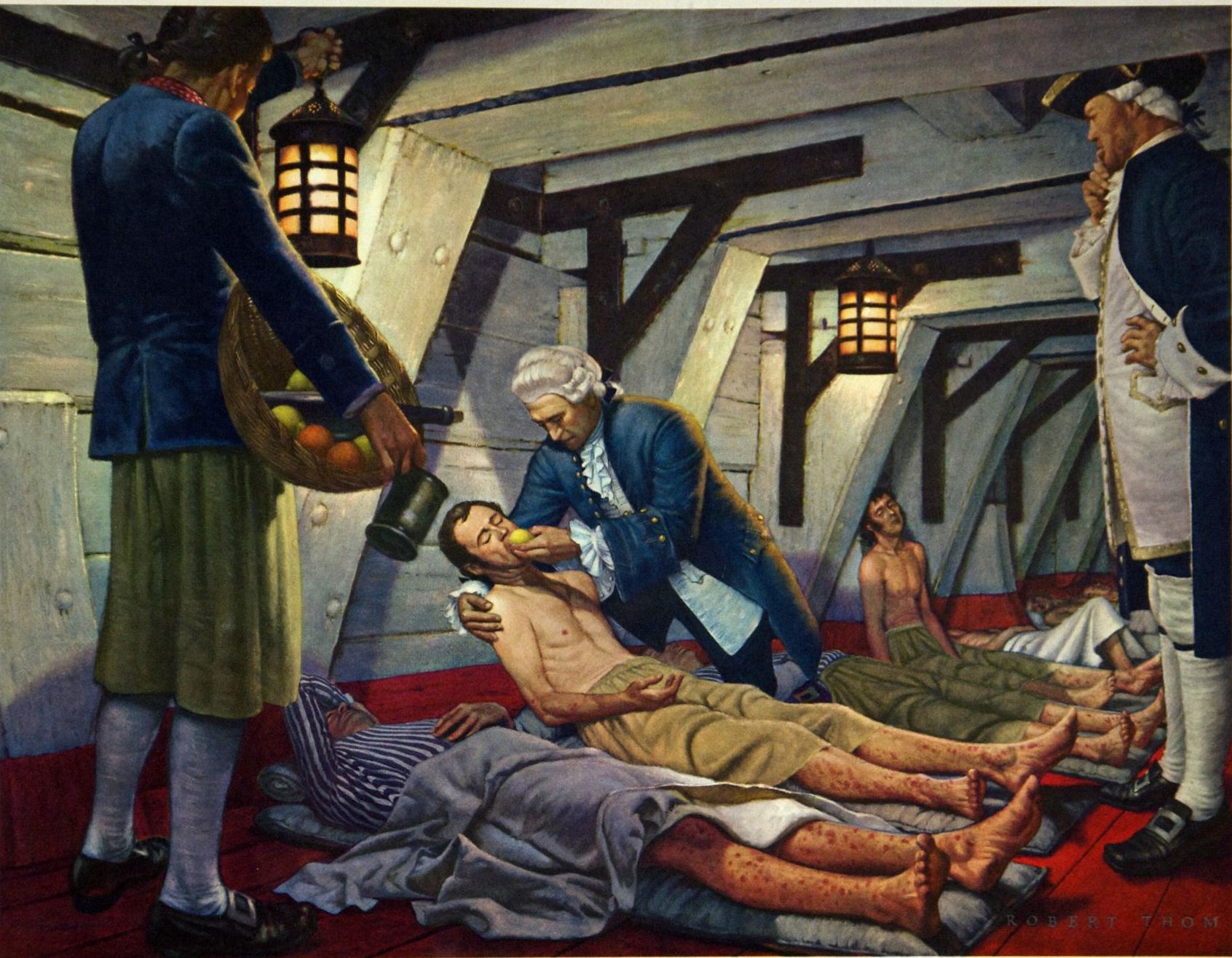
Below decks, as Robert Thom painted it in 1959
The fore-hold of HMS Salisbury, May 1747. Tap through it.
Start with the legs. Those red spots are blood leaking under the skin.
Twelve sailors here had it. Same gums, same spots, same weak knees, same room, same food.
The man in the blue coat is their surgeon, James Lind. He had a plan.
Give each pair of men a different remedy. This basket held one of them: oranges and lemons.
If one pair got better, the remedy would be the only thing that could explain it.
The experimentSix pairs, six cures
Day 1
Twelve men, as alike as Lind could find them.
Each pair gets one remedy: cider, an acid tonic, vinegar, sea water, a garlic paste, or two oranges and a lemon a day.
Your call. Which pair got up first? Tap a pair.
Six days pass.
Citrus. By day six one man was fit for duty and the other was nursing the sick. Cider came second.
Now look at the sea-water pair. They were the two sickest men in the room, and Lind chose to put them there.
Textbooks call this the first clinical trial, a generous title for twelve men, and the idea still earns it: every drug in your cabinet was tested by a descendant of it. Lind wrote it up six years later, in his own words.
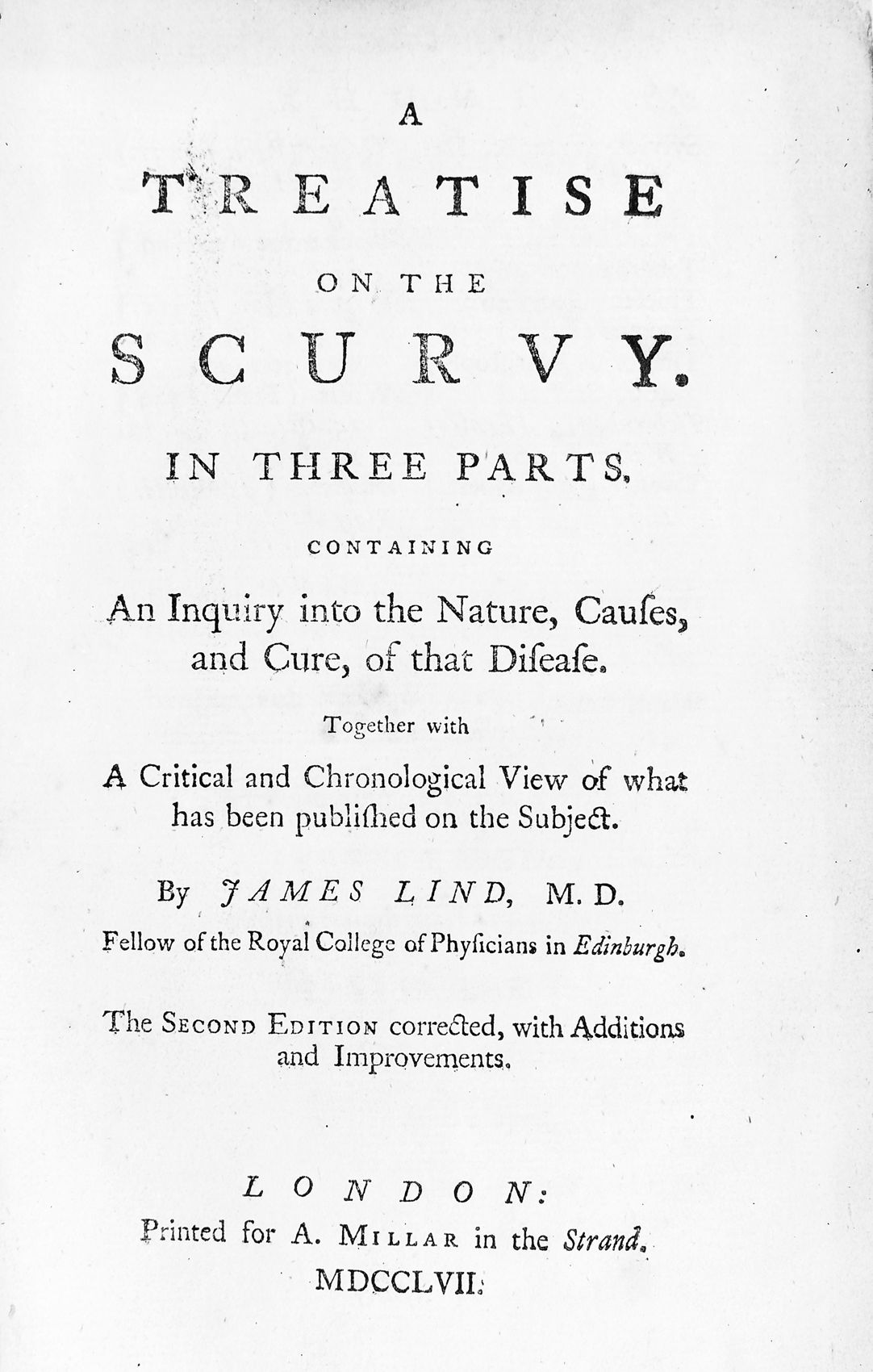
A Treatise of the Scurvy · 17531 / 5
The book itself. Swipe to read his account →
The patientsOn the 20th of May 1747, I took twelve patients in the scurvy, on board the Salisbury at sea. Their cases were as similar as I could have them. They all in general had putrid gums, the spots and lassitude, with weakness of their knees. They lay together in one place, being a proper apartment for the sick in the ; and had one diet common to all…
The remediesTwo of these were ordered each a quart of cyder a-day. Two others took twenty-five of three times a-day… Two others took two spoonfuls of vinegar three times a-day… Two of the worst patients… were put under a course of sea-water.
The fruitTwo others had each two oranges and one lemon given them every day. These they eat with greediness, at different times, upon an empty stomach. They continued but six days under this course, having consumed the quantity that could be spared.
The resultThe consequence was, that the most sudden and visible good effects were perceived from the use of the oranges and lemons; one of those who had taken them, being at the end of six days fit for duty… Next to oranges, I thought the cyder had the best effects.
←→
From Lind’s own account, abridged, with his spelling. Tap a dotted word for its meaning.
The flawWho chose the sea water?
1747The doctor decides1948Chance decides
A doctor who picks who gets what will steer each remedy toward the patients he expects it to suit, however honest he is.
The fix took two centuries. The 1948 streptomycin trial let random numbers do the choosing, hidden from the doctors enrolling patients.
The waitThe Navy took
0years
1753 · Lind buries itThe trial fills a few pages of a long book arguing that damp air and coarse food cause scurvy.
rob
Lind boils itTo carry fruit to sea he simmers the juice for hours. The heat destroys much of what worked.
1780s · Gilbert Blane pushesA fleet physician who keeps urging citrus on the Admiralty.
1794
The Suffolk proves itTwenty-three weeks non-stop to India with lemon juice in the grog, and no serious outbreak.
1795
Every sailor gets lemon juiceAbout three-quarters of an ounce a day, forty-eight years after the oranges.
Meanwhile, Captain CookCook sailed round the world in 1768 to 1771 without losing a man to scurvy, and gave the credit to malt, which holds no vitamin C.
The scienceWhat was in the fruit
Your skin, gums and blood vessels are held together by collagen, a protein built like rope.
Tying each new strand takes vitamin C. Without it the rope comes out weak, vessels leak, and old wounds come apart.
You carry about 1,500 mg. With no fresh food it drains, and below about 350 mg, within 4 to 12 weeks, the signs appear.
About 10 mg a day prevents it. One orange holds 70.
The other cures had none of it. Acid and vinegar are sour but empty, cider holds a trace, and sea water dries you out: you lose more water flushing the salt than you drank.
Most animals make their own vitamin C. Humans, guinea pigs and fruit bats lost the gene for it, so we have to eat it.
That is why two Norwegian doctors could give guinea pigs scurvy in 1907, and why Charles Glen King’s lab could prove in 1932 that the missing substance was vitamin C, 185 years after the fore-hold.
The Navy later swapped lemons for West Indian limes, with roughly a quarter of the vitamin, and scurvy came back on polar voyages into the twentieth century. The lime ration also left British sailors with a nickname: limeys.
Five things to tell your friends
1 of 5Anson sailed with 1,854 men and came home with 188.
2 of 5The first clinical trial was twelve sailors, six pairs and six days.
3 of 5Humans, guinea pigs and fruit bats are among the few animals that can’t make vitamin C.
4 of 5Captain Cook beat scurvy and credited malt, which has no vitamin C.
5 of 5“Limey” comes from the Navy’s lime juice, the weaker fruit.
Your turnTest a modern claim
Vitamin C is still argued over, this time against the common cold. Open the review below, read only the abstract, and put Lind’s questions to it.
Compared with what?Tap to flip
A similar group that did not get it, named plainly.What you want to hear
Who chose who got what?Tap to flip
Chance, with the doctors unable to steer it.What you want to hear
How many, for how long?Tap to flip
Enough people, followed long enough. Lind had two a side.What you want to hear
How much better, at what?Tap to flip
A number, on an outcome you care about.What you want to hear
It pools 29 trial comparisons and 11,306 people against placebo, mostly randomised and double-blind. Taken daily, vitamin C barely changed the risk of catching a cold, a risk ratio of 0.97. It shortened adults’ colds by 8 percent, about half a day on a week-long cold, and starting it once symptoms appeared showed no consistent effect.
When it comes upThe most famous trial in medicine took twelve sailors and six days, and the Navy still needed forty-eight years to act on it.
 George Anson
 The book itself. Swipe to read his account →